Nutmeg
Reviewed by medical experts · For informational purposes only
Introductory summary
Nutmeg known as Jatiphala in Ayurveda consists of the dried seed kernels of Myristica fragrans. It possesses Pungent and Bitter tastes with Light and Sharp qualities. Its Hot potency and Pungent post digestive effect enable it to effectively pacify Kapha and Vata doshas. It is a powerful Grahi or absorbent agent making it highly effective for treating diarrhea dysentery and malabsorption syndrome known as Grahani. It acts as a Dipana or appetizer and is renowned for removing bad breath and excess moisture from the mouth. Therapeutically it is indicated for respiratory disorders like cough and asthma and reproductive issues like spermatorrhoea due to its aphrodisiac properties. The Ayurvedic Pharmacopoeia of India recommends a dosage of 0.5 to 1 gram of the seed powder.
Nutmeg
Nutmeg, scientifically known as Myristica fragrans, is a well-known spice and medicinal herb. In Ayurveda, it is referred to as Jatiphala. It consists of the dried endosperm (kernel) of the seed. It is highly valued in traditional medicine for its aromatic, digestive, and aphrodisiac properties. It is a key ingredient in formulations used to treat digestive disorders like diarrhea and respiratory issues like asthma.
1. Name of the Herb
- Common Name: Nutmeg.
- Scientific Name: Myristica fragrans Houtt..
- Sanskrit Names: Jatiphala, Jati-sasya.
- Regional Names: Jaiphal (Hindi/Bengali/Marathi/Punjabi), Jayfar (Gujarati), Jadikai (Kannada), Jathikkai (Tamil), Jajikaya (Telugu), Jatika (Malayalam).
2. Brief Description
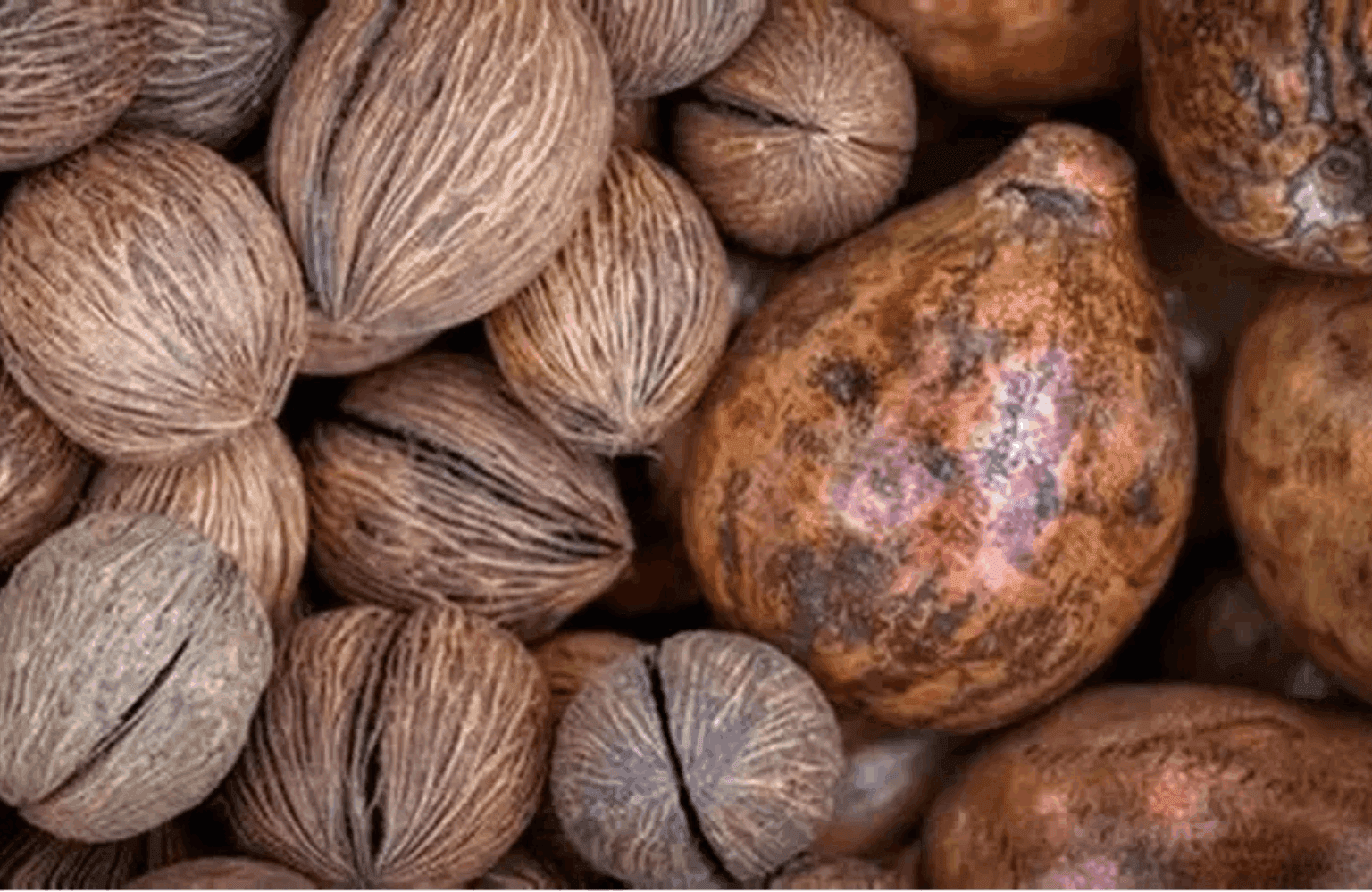
Nutmeg comes from a moderate-sized aromatic tree, approximately 10-20 meters high. The medicinal part is the seed (specifically the kernel), which is ellipsoid in shape, greenish-black or brown externally, and possesses a strong aromatic odor and a pungent taste. In Ayurveda, it is considered a powerful Dipana (appetizer) and Grahi (absorbent/bowel binder) agent, often used to check excessive fluid loss from the body.
3. Source / Part Used
- Plant Source: Herbal / Plant-based.
- Part Used: Seed (Endosperm/Kernel). Note: The aril (outer covering) is known as Mace (Jatipatri or Jatidala) and is also used in Ayurveda.
4. Ayurvedic Properties
According to the Ayurvedic Pharmacopoeia of India:
- Rasa (Taste): Katu (Pungent) and Tikta (Bitter).
- Guna (Qualities): Laghu (Light) and Tikshna (Sharp).
- Virya (Potency): Ushna (Hot).
- Vipaka (Post-digestive effect): Kaṭu (Pungent).
- Dosha Effect: Kaphavatapana (Pacifies Kapha and Vata doshas).
5. Key Benefits
- Improves Digestion: Acts as Dipana (appetizer), stimulating the digestive fire.
- Controls Diarrhea: It is Grahi, meaning it absorbs moisture from the intestines and binds the stool, making it effective for diarrhea and dysentery.
- Oral Health: Acts as Mukhakledanasaka (removes excess saliva/moisture from the mouth) and Mukha-daurgandhyanasaka (removes bad breath).
- Respiratory Support: Beneficial for Kasa (Cough) and Svasa (Asthma).
- Reproductive Health: Classified as Vrishya (Aphrodisiac) and is used to treat Sukrameha (urinary disorders related to semen).
6. Uses / Indications
Nutmeg is indicated in Ayurveda for the following conditions:
- Digestive Disorders: Atisara (Diarrhea), Grahani (Malabsorption syndrome/IBS), Chardi (Vomiting), and Aruci (Loss of taste/Anorexia).
- Respiratory Disorders: Svasa (Asthma/Dyspnoea), Kasa (Cough), and Pinasa (Chronic Rhinitis).
- Oral Conditions: Mukharoga (Diseases of the mouth) and bad breath.
- Reproductive: Sukrameha (Spermatorrhoea).
7. How It Works
- Absorption: Due to its Grahi property, it helps absorb excessive fluids in the intestines, providing relief in loose motions and malabsorption.
- Cleansing: Its Tikshna (sharp) and Katu (pungent) qualities help clear mucus (Kapha) from the throat and lungs, aiding in respiratory issues.
- Aromatic Action: The essential oils present in the seed act as a deodorant for the mouth and a stimulant for the digestive system.
8. Dosage
The recommended dosage according to the Ayurvedic Pharmacopoeia of India is:
- Powder (Churna): 0.5 to 1.0 gram.
9. Safety Information
Nutmeg is safe when used in the small, recommended therapeutic doses (0.5 to 1 gram). It is a potent herb (Tikshna) and should be treated as a medicine rather than just a food ingredient when taken daily.
10. Side Effects
- Heat: Due to its Ushna (Hot) potency, excessive intake may increase body heat or aggravate Pitta dosha.
- Sharpness: Its Tikshna (Sharp) quality means it acts quickly but can be irritating if taken in excess.
11. Precautions
- Dosage Adherence: Strictly adhere to the low dosage (0.5 - 1 g) as it is a potent drug.
- Pregnancy: Consult an Ayurvedic physician before use, especially in therapeutic doses, due to its hot potency.
12. Storage Instructions
- Store in a cool, dry place.
- Keep in an air-tight container to preserve the volatile essential oils and aroma.
13. References
-
WHO Monographs on Selected Medicinal Plants – Myristicae semen
https://apps.who.int/iris/handle/10665/42052
-
WHO Global Report on Traditional and Complementary Medicine
https://www.who.int/publications/i/item/9789241515436
-
Codex Alimentarius (FAO/WHO) – Nutmeg Standards
https://www.fao.org/fao-who-codexalimentarius
-
Ayurvedic Pharmacopoeia of India (API) – Jatiphala
https://www.ayush.gov.in
-
Spices Board of India – Nutmeg Information
https://www.indianspices.com
-
PubMed – Myristica fragrans Research Articles
https://pubmed.ncbi.nlm.nih.gov/?term=Myristica+fragrans
-
NCBI Taxonomy Database – Myristica fragrans
https://www.ncbi.nlm.nih.gov
-
ScienceDirect – Nutmeg Phytochemistry & Pharmacology
https://www.sciencedirect.com/topics/pharmacology-toxicology-and-pharmaceutical-science/myristica-fragrans
-
SpringerLink – Clinical & Experimental Studies on Nutmeg
https://link.springer.com
-
Wiley Online Library – Nutmeg Research Articles
https://onlinelibrary.wiley.com
14. FAQs
** **Q. Can it be taken daily?
In culinary amounts (a pinch), it is generally safe. For medicinal use, it is taken in doses of 0.5 to 1 gram for specific conditions like diarrhea or cough.
Q. When should it be taken?
It is often included in formulations taken to improve digestion or stop diarrhea, typically associated with meals or buttermilk.
Q. Can it be taken with milk/water?
Yes, it can be taken with water. In traditional formulations like Jatiphaladi Curna, it may be taken with honey or buttermilk (Takra) depending on the condition.
Consult a Doctor
- AG4.5Dr Anshuman Gupta
Ayurveda8 yrs exp
- MS4.2Midun s kumar
Ayurveda4 yrs exp
- SP4.5Dr Sreelekha P Nair
Ayurveda6 yrs exp
- D4.3Dr Divya
Ayurveda2 yrs exp