Scabies
Reviewed by medical experts · For informational purposes only
Introductory summary
Scabies correlates with the Ayurvedic conditions Pama and Kacchu classified under Kshudra Kustha. It is explicitly recognized as an Aupasargika Roga meaning a contagious disease that spreads through direct physical contact or sharing personal items. The condition arises from the vitiation of Kapha and Pitta doshas which contaminate the skin and blood. Symptoms include intense itching known as Kandu and the formation of pustules called Pidaka often accompanied by discharge. Pama typically appears on the hands while Kacchu presents as larger hard lesions on the buttocks. Management prioritizes topical therapies using antimicrobial herbs like Neem and Sulphur or Gandhaka formulations such as Marichyadi Taila to eliminate the infestation and soothe the skin.
Scabies
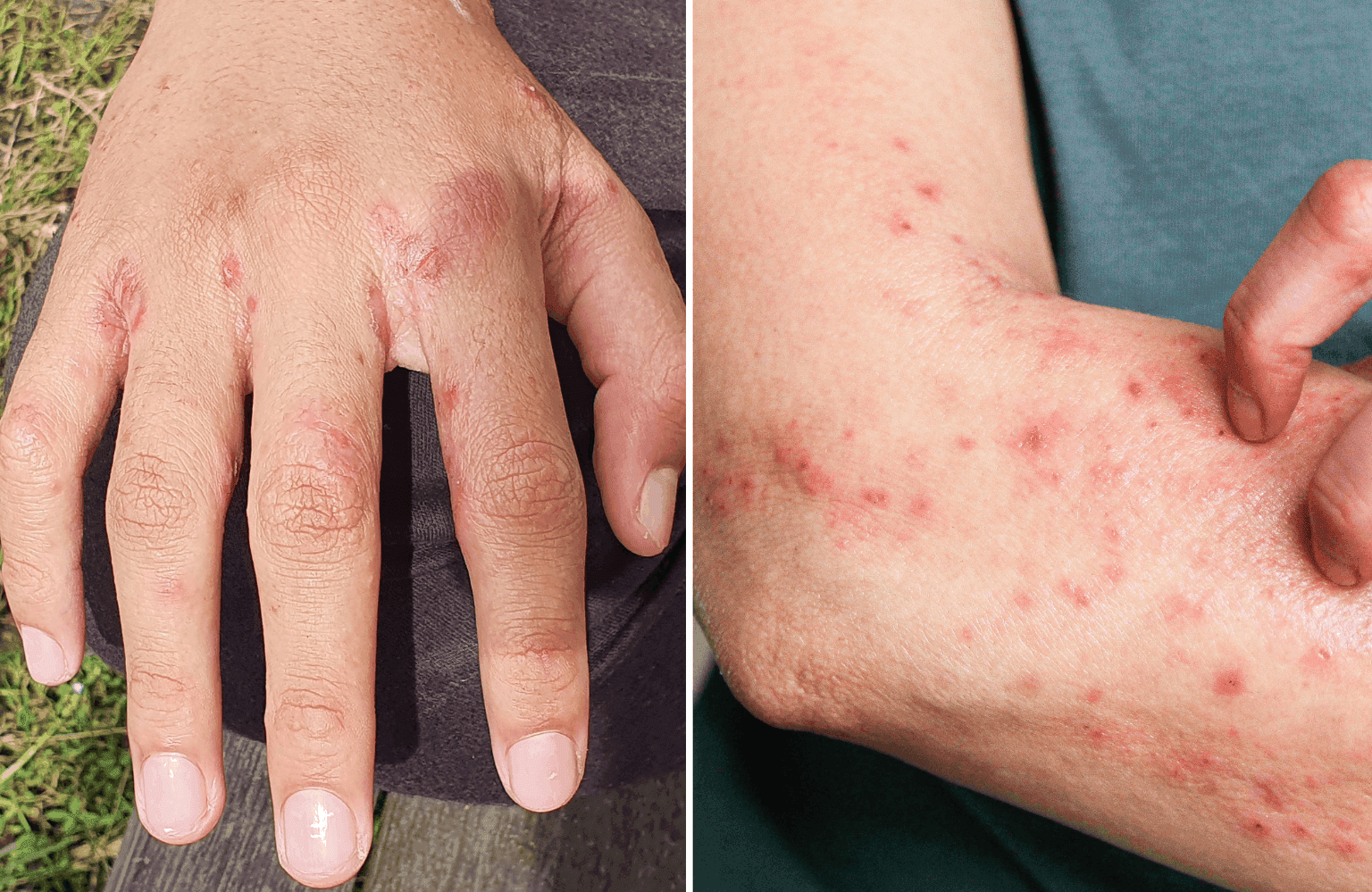
Scabies is a contagious skin infestation by the mite Sarcoptes scabiei that causes intense itching and pimple-like skin rash. In Ayurveda, this condition correlates with specific types of Kustha (skin diseases), predominantly Pama and Kacchu. These are classified as Kshudra Kustha (minor skin diseases) but are significant due to their symptoms of intense itching (Kandu), pustules (Pidaka), and discharge (Srava). Ayurveda explicitly recognizes this as a contagious disease (Aupasargika Roga) that spreads through physical contact.
1. Definition
Modern Definition: An itchy skin condition caused by a tiny burrowing mite called Sarcoptes scabiei. Intense itching occurs in the area where the mite burrows.
Ayurvedic Definition:
- Pama: A skin condition characterized by numerous small pustules (Pidaka) that are white, reddish, or dark, accompanied by intense itching (Kandu) and burning sensation (Daha).
- Kacchu: A condition similar to Pama but characterized by larger, harder pustules, often appearing on the buttocks and loins, accompanied by severe itching.
2. Etymology & Conceptual Meaning
- Pama: The term generally refers to a condition of "scab" or "eczema" characterized by suppuration and itching.
- Kacchu: The name suggests a resemblance to the rough skin of a tortoise or relates to the painful itching sensation.
- Conceptual Interpretation: Ayurveda views these conditions as a disturbance of the Kapha and Pitta doshas. Kapha causes the itching and swelling, while Pitta causes the redness, burning, and pus formation. These vitiated doshas affect the Twak (skin), Rakta (blood), Mamsa (flesh), and Lasika (lymph).
3. Causes (Nidana)
The causes are multifactorial, involving diet, lifestyle, and direct contact with infection.
- Contagion (Aupasargika Roga): Madhava Nidana and Sushruta Samhita explicitly list skin diseases (Kustha) as contagious. They spread through Gatrasamsparsha (physical contact), Nishvasat (breath/close proximity), Sahashayyasana (sharing beds and seats), and Vastramalyanu-lepana (sharing clothes, garlands, and unguents).
- Dietary Causes:
- Viruddha Ahara: Incompatible foods (e.g., milk with fish).
- Excessive intake of liquid (Drava), unctuous (Snigdha), and heavy (Guru) foods.
- Consumption of new grains (Navanna), curd, sour (Amla), and salty (Lavana) foods.
- Lifestyle Causes:
- Vegadharana: Suppression of natural urges (like vomiting).
- Mithya Vihara: Improper lifestyle habits such as day sleep (Divaswapna) and sudden temperature changes (cold water after heat).
4. Journey of the Disease (Pathogenesis/Samprapti)
- Samprapti Ghataka (Components):
- Pathogenesis:
- Due to contact with an infected person or dietary indiscretions, the Doshas (Kapha and Pitta) are vitiated.
- These Doshas travel through the channels and lodge in the skin (Twak) and superficial tissues.
- They contaminate the Rakta and Lasika.
- This leads to the formation of small blisters or pustules (Pidaka), accompanied by inflammation (Shotha) and itching (Kandu), manifesting as Pama.
5. Symptoms (Lakshana)
- Cardinal Symptoms of Pama:
- Pidaka: Appearance of numerous small pustules or papules.
- Kandu: Intense itching (a sign of Kapha).
- Srava: Discharge or oozing from the pustules.
- Daha: Burning sensation (a sign of Pitta).
- Location: Often found on the hands (Pani) and other parts of the body.
- Cardinal Symptoms of Kacchu:
- Similar to Pama but the lesions are harder and larger.
- Specifically located on the Sphik (buttocks) and loins.
- Severe burning and itching.
6. Different Types or Classification (Bheda)
While Pama and Kacchu are themselves specific subtypes of skin disease, Madhava Nidana classifies them under:
- Kshudra Kustha: Minor skin diseases (group of 11), which includes Pama and Kacchu.
- Dosha Dominance:
- Pitta-dominant Pama: Marked by redness, burning, and suppuration.
- Kapha-dominant Pama: Marked by severe itching and thick discharge.
- Dry Pama (Vata): Rough, dry lesions with itching (less common in classical Pama descriptions).
7. Diagnosis
- Ayurvedic Diagnosis (Roga Pariksha):
- Darshana (Observation): Inspecting the size, color, and nature of the pustules (e.g., white, reddish, or blackish).
- Prashna (Questioning): Inquiring about itching intensity (usually worse at night due to Kapha/warmth) and history of contact with others sharing the same symptoms (contagion).
- Sparshana (Touch): Checking for discharge (Srava) or roughness.
- Differential Diagnosis:
- Differentiated from Vicharchika (Eczema), which usually has darker pigmentation and lichenification, whereas Pama presents with distinct pustules.
8. Disease Management
Management focuses on destroying the "germs" (Krimighna), purifying the blood (Raktashodhana), and relieving itching (Kandughna).
Medicines (External & Internal)
- Gandhaka (Sulphur): Pure Sulphur is considered the supreme remedy for skin diseases. Ayurveda Prakasha states that Gandhaka cures Kandu (itching), Visarpa, and Kustha. It dries up the discharge and kills pathogens.
- Marichyadi Taila: A specific oil containing black pepper (Maricha), toxins (Visha), and other herbs, indicated for Pama, Kustha, and Kacchu.
- Sinduradya Taila: An oil formulation containing vermilion (Sindura) used for curing Pama and Kacchu.
- Jiraka-adi Taila: An oil processed with Cumin (Jiraka) and Sindura, specifically mentioned to destroy Pama.
- Khadira: Acacia catechu is a primary blood purifier used in decoctions.
- Aragvadha: Used in pastes (Lepa) to cure skin diseases and cleanse wounds.
Panchakarma (Therapies)
- Vamana (Emesis): Since Pama involves Kapha and Pitta, therapeutic vomiting is indicated to expel Doshas from the upper body.
- Virechana (Purgation): The primary treatment for Pitta and Rakta disorders. It helps clear the blood of toxins.
- Raktamokshana (Bloodletting): In severe cases with burning and redness, letting out impure blood is recommended.
Diet (Ahara)
- Pathya (Beneficial): Light foods, bitter vegetables (like Patola/pointed gourd, Nimba/Neem), and old grains.
- Apathya (Avoid): Sour foods, curd, milk, jaggery, sesame, black gram, and incompatible foods (Viruddha Ahara).
9. Prognosis
- Sadhya (Curable): Pama and Kacchu are generally considered curable (Sadhya) as they are Kshudra Kustha, provided the patient follows hygiene and diet restrictions.
- Krichrasadhya (Difficult): If the condition becomes chronic, spreads extensively, or if the patient continues the intake of incompatible foods.
10. Modern Correlations
- Scabies: The symptoms of Pama (itchy pustules, vesicles) and Kacchu (buttock lesions) correlate directly with the clinical presentation of Scabies.
- Contagion: The Ayurvedic classification of Kustha as an Aupasargika (contagious) disease perfectly aligns with the transmission mode of Scabies mites.
- Secondary Infection: The mention of Srava (discharge) and Paka (suppuration) in Ayurveda correlates with secondary bacterial infections (impetigo) often seen in scabies scratch marks.
11. References
-
WHO – Scabies (Fact Sheet)
🔗 https://www.who.int/news-room/fact-sheets/detail/scabies
Official WHO overview: epidemiology, transmission, symptoms, and global burden.
-
WHO – Neglected Tropical Diseases: Scabies
🔗 https://www.who.int/teams/control-of-neglected-tropical-diseases/scabies
Classification of scabies as an NTD and WHO control strategies.
-
The Lancet – Scabies: A Global Disease
🔗 https://www.thelancet.com/journals/laninf/article/PIIS1473-3099(17)30440-6/fulltext
Landmark review discussing global prevalence and public health impact.
-
NCBI – Scabies: Epidemiology, Diagnosis, and Treatment
🔗 https://www.ncbi.nlm.nih.gov/books/NBK431058/
Detailed scientific reference suitable for research articles.
-
Indian Journal of Dermatology – Scabies in India
🔗 https://ijdvl.com/scabies-a-re-emerging-infestation/
Indian epidemiology and resistance patterns.
12. FAQ Section
Q: Is Scabies contagious according to Ayurveda?
A: Yes. Ayurveda lists skin diseases like Pama under Aupasargika Rogas (contagious diseases). It states that the disease spreads through contact (Gatrasamsparsha), sharing beds, clothes, and ornaments.
Q: What is the best Ayurvedic remedy for Scabies itching?
A: Gandhaka (Purified Sulphur) is highly praised in texts like Ayurveda Prakasha for curing Kandu (itching) and Pama. It is often used in oils or internal preparations. Neem (Nimba) is also a powerful remedy.
Q: Can diet help cure Scabies?
A: While external treatment is primary, diet helps prevent aggravation. Ayurveda recommends avoiding "heating" and "fermented" foods like sour curd, pickles, and excessive salt, as well as incompatible foods like milk with fish, which worsen skin inflammation.
Q: What is "Kacchu" in Ayurveda?
A: Kacchu is a type of skin disease very similar to Pama (Scabies) but characterized by harder, larger pustules, typically located on the buttocks and loins, accompanied by severe burning and itching.
Consult a Doctor
- MS4.2Midun s kumar
Ayurveda4 yrs exp
- SP4.5Dr Sreelekha P Nair
Ayurveda6 yrs exp
- VR4.2Vaidya Rohit Kumar
Ayurveda3 yrs exp
- V4.1Vairamuthu
Ayurveda8 yrs exp
Buy Medicine
 Prescribed to you4.7₹11 cashback
Mahamarichyadi Taila (Kalera) Kalera
Skin disease, anti-fungal oil
Bottle of 50 ml
4.7
₹110Get ₹11 Cashback