

Toothache Home Remedies and the Ayurvedic View
Reviewed by medical experts · For informational purposes only
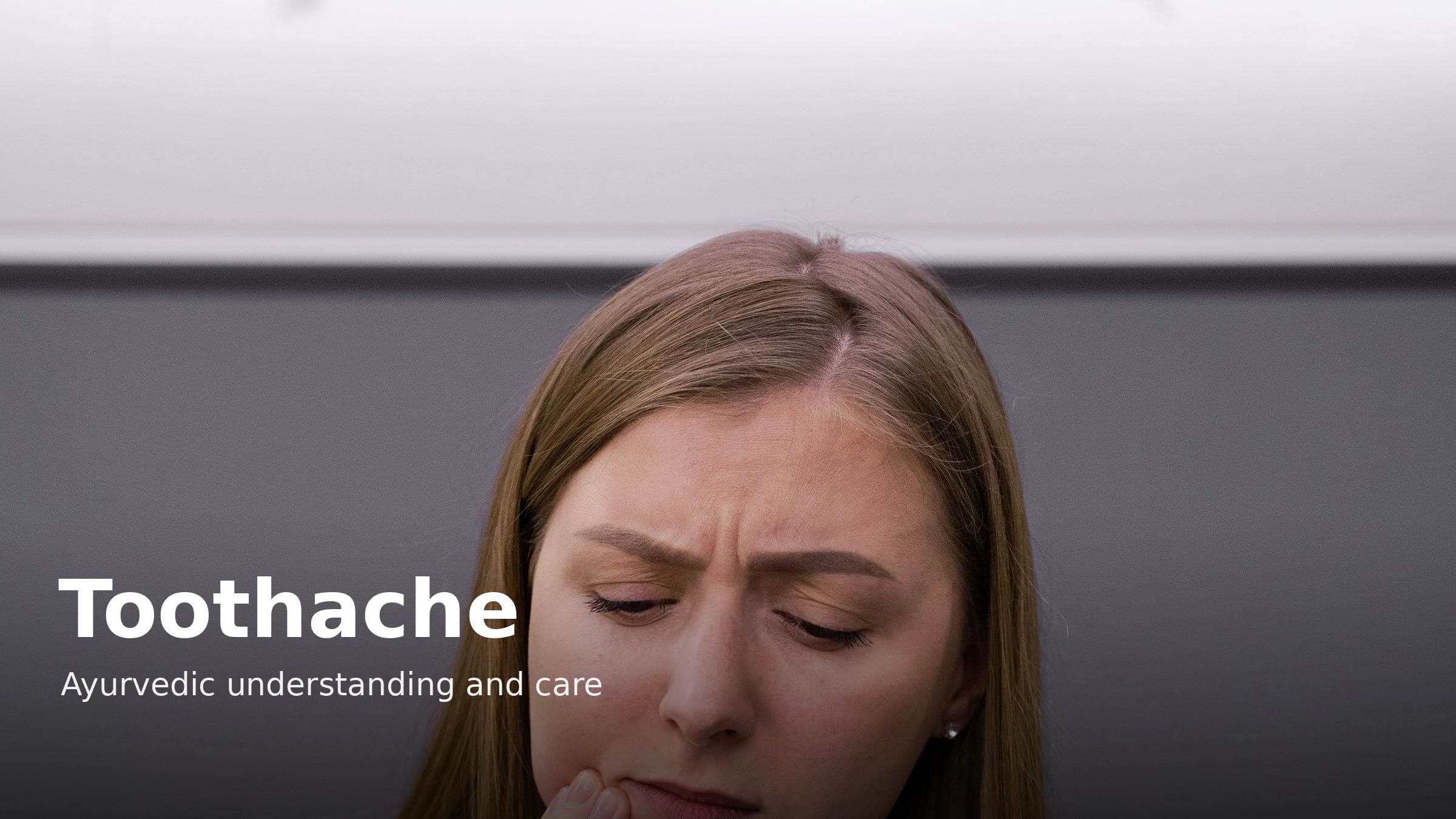
Introductory summary
Toothache means decay, abscess or gum trouble until proven otherwise. Safe home relief, the classical view, and the red flags that need urgent care.
1. Definition
Toothache is pain in or around a tooth. Its common causes - decay reaching the nerve, a cracked tooth, a dental abscess, gum disease, or an erupting wisdom tooth - are physical problems inside the mouth, so toothache almost always needs a dentist, not just pain relief. Painkillers and home measures are a bridge to the appointment, never the destination.
Classical Ayurveda describes dental disorders among the Danta-roga, including Danta-shula (tooth pain) and Krimi-danta - "organisms" damaging the tooth, the classical picture of decay. Daily oral care with herbal sticks and oil-holding (Gandusha/Kavala) is an old and elaborate part of the classical routine (Dinacharya). These are traditional interpretive frameworks, not exact translations of modern dental diagnoses.
2. Etymology & Conceptual Meaning
- Danta-shula means tooth pain; Danta-harsha means dental sensitivity.
- Krimi-danta describes tooth destruction by Krimi (micro-organisms) - remarkably close to the modern bacterial-decay model.
- Gandusha and Kavala are oil-holding and oil-gargling practices for oral strength and hygiene.
- Khadira, Jambu, Lavanga (clove) and Babul are classical astringent, antiseptic dental herbs.
These terms explain a traditional model of oral disease. Modern dentistry maps the same pain to decay, pulpitis, abscess or gum disease - each with a specific mechanical treatment.
3. Causes (Nidana)
In the traditional account, dental disease follows sugary, sticky food; poor oral cleaning; and Vata-Kapha aggravation weakening the teeth and gums. These are traditional explanations that rhyme with the modern story.
In modern dentistry, tooth decay is caused by bacteria metabolizing sugar into acid that dissolves enamel and dentine; once decay reaches the pulp, infection and inflammation produce severe pain, and a neglected cavity becomes an abscess. Other causes: cracked teeth, loose fillings, gum recession exposing roots, wisdom-tooth infection, sinusitis (mimicking upper-tooth pain) and jaw-clenching.
4. Journey of the Disease (Pathogenesis / Samprapti)
In the traditional account, Krimi first damages the tooth's surface; unchecked, the damage deepens, Vata lodges in the cavity, and sharp, throbbing pain follows - worse with cold, sweet and night-time. This is a traditional explanatory model, not a proven account of dental pathology.
In modern understanding, decay progresses enamel, dentine, pulp. Enamel decay is silent; dentine decay gives sensitivity; pulpitis gives throbbing pain that wakes you at night; death of the pulp and abscess formation give constant pain, swelling, and sometimes fever. The direction of travel without treatment is always deeper - which is why waiting out a toothache fails.
Samprapti Ghataka: a traditional interpretive framework
| Component | Traditional interpretation, not a laboratory diagnosis |
|---|---|
| Dosha | Vata predominant in pain; Kapha in swelling |
| Dushya | Asthi (bone/tooth tissue) and Mamsa (gums), traditional concepts |
| Srotas | Channels of the oral cavity, traditional concept |
| Srotodushti | Sanga (blockage) and Kshaya (decay), traditional concepts |
| Agni | Not central in the traditional account |
| Ama | Sometimes implicated traditionally in gum disease |
| Adhisthana | Danta (teeth) and Danta-mula (gums) |
These are not validated categories for diagnosing dental disease; a dentist's examination and X-rays do that.
5. Symptoms (Lakshana)
Toothache can be sharp, throbbing or constant; triggered by hot, cold, sweet or biting; and may come with gum swelling, a bad taste, or pain spreading to the ear, jaw or head. Sensitivity to cold that fades quickly is early; pain that lingers or wakes you at night suggests the nerve is involved.
See a dentist urgently - or emergency care - for: swelling of the face or floor of the mouth, fever or feeling unwell with dental pain, difficulty swallowing or breathing, or trouble opening the mouth. A spreading dental infection can become life-threatening; these signs are not "wait and see" territory.
6. Different Types or Classification (Bheda)
Modern classification is by source: reversible irritation (early decay, sensitivity), pulpitis, abscess, gum-disease pain, and non-dental mimics (sinus, jaw joint, neuralgia). Each has a distinct treatment - filling, root canal, drainage, gum therapy.
The classical tradition distinguishes Vata-type pain (sharp, shooting), Kapha-type (dull, swollen) and Pitta-type (burning, inflamed), guiding traditional care. Traditional pattern labels cannot tell a cavity from an abscess; examination and X-rays do that.
7. Diagnosis
A dentist examines the mouth, tests the tooth (tapping, cold), and takes X-rays to find decay, cracks, abscesses and bone loss. Treatment follows the finding: filling, root canal treatment, extraction, gum therapy, or antibiotics only when infection is spreading - antibiotics do not fix a cavity.
In the traditional framework, a practitioner assesses dosha pattern, digestion and oral habits. This cannot locate a cavity or an abscess; a dental examination comes first whenever pain is persistent.
8. Disease Management
Food (Ahara)
Until you see the dentist: chew on the other side, avoid very hot, cold and sweet foods, and favour soft food. Longer term, cutting sugary drinks and frequent sweet snacks is the single biggest decay-prevention step. Classical texts advise against excessively hot, cold and hard foods for weak teeth - sensible advice in any framework.
Lifestyle (Vihara)
Brush twice daily with fluoride toothpaste (spit, don't rinse), clean between teeth, and see a dentist regularly - decay caught early is a small filling. Oil pulling (Gandusha) is a classical daily practice with modest supporting evidence for oral bacteria and gum health; it is a reasonable addition to brushing, never a replacement for it or for dental treatment. Don't smoke; smoking worsens gum disease and healing.
Medicines and traditional formulations
Over-the-counter painkillers (paracetamol or ibuprofen, taken as directed) are the right bridge to a dental appointment; a cold compress on the cheek helps swelling. Clove oil (Lavanga) is the classical toothache remedy - eugenol genuinely numbs - useful for temporary relief, but it does not treat the cause. Classical formulations use Khadira, Jambu and Babul for oral care. No herbal remedy treats an abscess or a dying nerve: that needs a dentist, and delaying can turn a filling into an extraction. Discuss any herbal products with your dentist, doctor or a qualified Ayurvedic practitioner, especially in pregnancy or alongside other medicines.
Panchakarma and external therapies
Gandusha and Kavala are the classical oral therapies, done at home as hygiene support. No panchakarma procedure treats dental disease. Claims of reversing established cavities without drilling should be treated with caution - early enamel changes can remineralize with fluoride and diet, but a true cavity does not heal itself.
9. Prognosis (Expected Course and Outcome)
Treated early, toothache ends with a simple filling and the tooth is saved. Delayed, the same tooth may need a root canal, then extraction, and a spreading infection can become dangerous. Painkillers can mask pain while decay quietly advances - relief is not resolution. Classical texts likewise urge treating dental disease before it deepens and loosens the tooth.
10. Modern Correlations
The classical Krimi-danta model of organism-driven tooth destruction anticipates the bacterial-decay story strikingly, and classical oral-hygiene practice was sophisticated. Where they part company is treatment: modern dentistry can actually repair or remove the diseased structure, and antibiotics control spreading infection. Traditional terms should be presented as a separate framework, with its limits stated. Persistent toothache needs a dentist - traditional supportive care can only accompany that.
11. References
Traditional background
The Ayurveda notebook draws on discussions of Danta-roga, Danta-shula and Krimi-danta in Sushruta Samhita (Nidana Sthana 16, Chikitsa Sthana 22, Uttara Tantra), Charaka Samhita (Sutra Sthana 5 on Dinacharya) and Ashtanga Hridaya (Uttara Tantra 21-22, Mukha-roga). These are background for traditional concepts, not clinical proof of treating dental disease. Exact verse citations and formulation indications should be checked by a qualified Ayurvedic editor before being quoted as direct text.
Modern clinical information
Government and institutional resources
The institutional links are general resources, not endorsements of the treatment claims in this article.
12. FAQ Section
Will a toothache go away on its own?
Pain may fade as the nerve dies - which is worse, not better. The decay or infection keeps progressing. Toothache needs a dentist; painkillers only buy time.
What helps until my dental appointment?
Paracetamol or ibuprofen as directed, chewing on the other side, avoiding hot/cold/sweet triggers, a cold compress for swelling, and clove oil dabbed on the tooth for temporary numbing.
Does oil pulling fix cavities?
No. Oil pulling may modestly reduce oral bacteria as a hygiene add-on, but an established cavity or abscess needs dental treatment. Delaying risks losing the tooth.
When is toothache an emergency?
Facial swelling, fever or feeling unwell with the pain, difficulty swallowing or breathing, or limited mouth opening - get urgent care; spreading dental infection can be life-threatening.
Is clove oil safe?
For brief topical use on a painful tooth, generally yes - it numbs via eugenol. It is not a treatment, and concentrated oil can irritate gums; keep it away from children.
Related reading
Browse our Disease A to Z for more conditions.
Medical disclaimer: This article is for education, not an individual diagnosis or prescription. Persistent toothache needs a dentist; facial swelling, fever, or difficulty swallowing or breathing needs urgent medical care. Discuss all medicines and supplements with a qualified clinician.
Consult a Doctor
- KC5.0Dr. Kamesh chand sharma
Ayurveda2 yrs exp
- PP4.4Dr prince patel
Ayurveda22 yrs exp
- AK4.8Dr. Amalnath K Viswanathan
Ayurveda4 yrs exp
- PJ5.0Dr. P. JOTEENDRA
Ayurveda2 yrs exp