

Varicocele Symptoms and Causes
Reviewed by medical experts · For informational purposes only
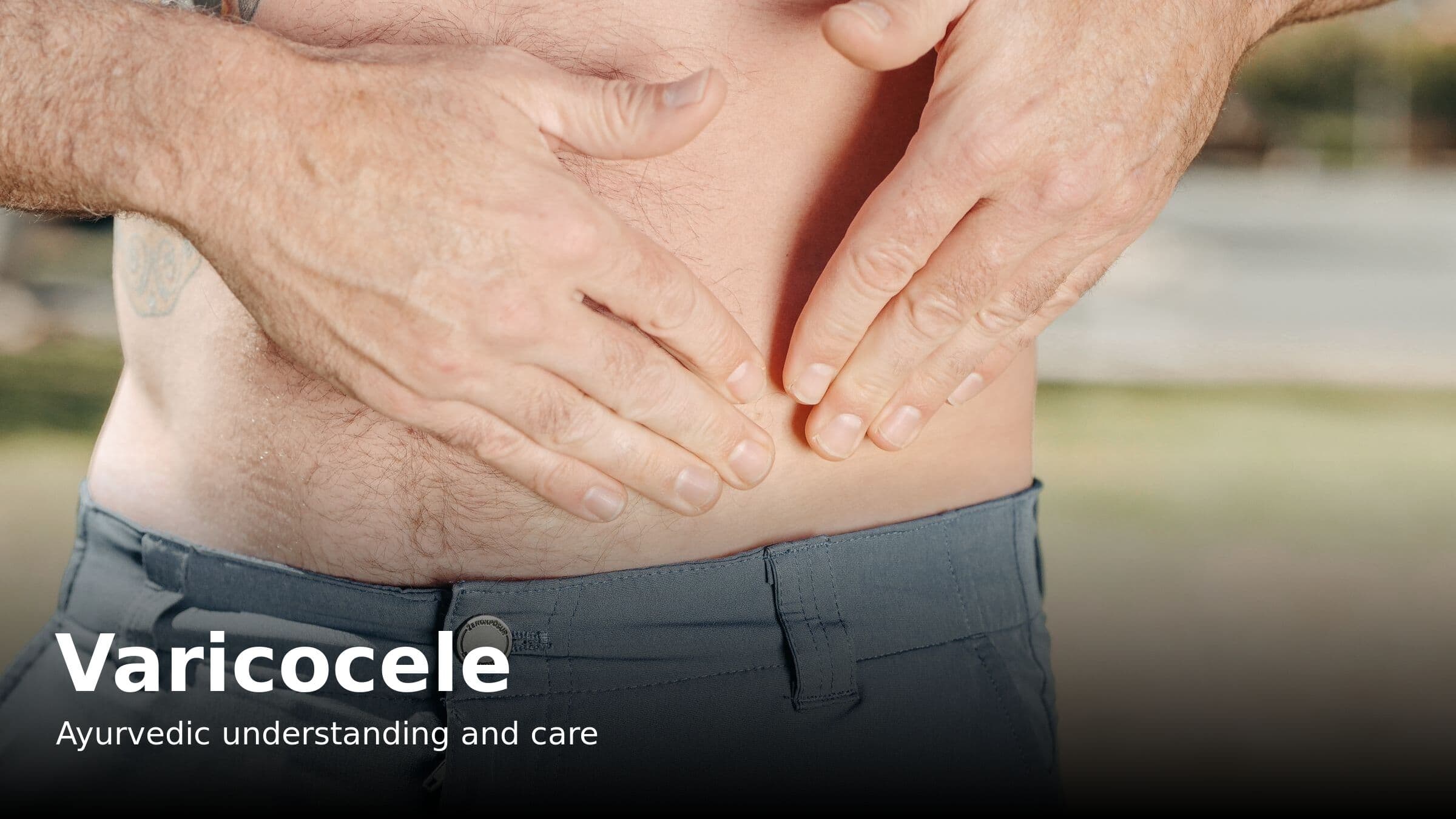
Introductory summary
Varicocele explained: symptoms, scrotal examination, fertility concerns and treatment options, with a cautious Ayurvedic perspective and clear safety limits.
1. Definition
A varicocele is an enlargement of veins within the scrotum, the skin pouch holding the testicles. It often develops around puberty, is usually on the left side, and may cause no symptoms. Some people have a dull ache, a visible or palpable cluster of veins, reduced testicular growth or fertility problems.
There is no exact, universally accepted classical Ayurvedic equivalent for the modern diagnosis. Discussions of Siraja Granthi, Vriddhi and Shukravaha Srotas offer possible traditional comparisons. These should not be presented as proof that a classical text described the same condition or that Ayurvedic treatment repairs faulty venous valves.
2. Etymology & Conceptual Meaning
- Sira means a vessel or vein in this context.
- Granthi refers to a knot or swelling.
- Vriddhi refers to enlargement and includes several kinds of swelling, not only varicocele.
- Shukravaha Srotas is a traditional framework for reproductive functions and their channels.
These terms can guide an Ayurvedic discussion of symptoms. A scrotal swelling still needs a medical examination because a hernia, hydrocele, infection or other problem may look similar.
3. Causes (Nidana)
Modern understanding
A varicocele involves abnormal pooling of blood in scrotal veins. The exact cause is not fully understood. Valve function and the anatomy of venous drainage are thought to play a role. It is not established that eating a particular food, sexual activity or stress causes a varicocele.
Traditional dietary and lifestyle discussion
The Ayurveda notebook discusses Vata, physical strain and disturbed pelvic functions in relation to scrotal symptoms. These are traditional interpretations, not confirmed causes of varicocele. Diet advice should aim at general health and comfortable bowel movements, not promise to dissolve swollen veins.
Stress may make coping with pain or fertility concerns harder, but this does not make the condition psychological or the patient's fault.
4. Journey of the Disease (Pathogenesis / Samprapti)
Modern descriptions focus on blood collecting in the pampiniform venous plexus around the testicle. In some people this is associated with disturbed temperature regulation and impaired testicular function. Many people have no complications.
An Ayurvedic practitioner may discuss Vata-related discomfort, Rakta and Sira involvement, and reproductive-channel disturbance. This is a conceptual comparison, not a proven explanation of venous reflux.
Samprapti Ghataka: interpretive Ayurvedic framework
| Component | Possible traditional interpretation |
|---|---|
| Dosha | Vata may be considered in pain; assessment varies |
| Dushya | Sira and Rakta, with reproductive tissue considered when relevant |
| Srotas | Shukravaha and Raktavaha Srotas may be discussed |
| Srotodushti | Sanga or Siragranthi as traditional descriptions, not ultrasound findings |
| Agni | Assessed individually, not a proven cause of venous dilation |
| Ama | May or may not be considered; not equivalent to pooled blood |
| Adhisthana | Scrotal region in this comparison |
| Roga Marga | Depends on the traditional assessment; not a clinical grade |
5. Symptoms (Lakshana)
Early or mild presentation
A varicocele may be found incidentally without pain. When present, discomfort is often dull or aching, worse while standing or later in the day, and relieved by lying down.
Larger swellings or complications
There may be a cluster of veins described as a "bag of worms," a difference in testicular size, poor testicular development or difficulty conceiving. Not every varicocele causes infertility.
Sudden severe testicular pain is an emergency because testicular torsion and other urgent conditions must be excluded. Do not assume it is a known varicocele. A new lump, persistent swelling, fever or significant change also needs medical assessment.
6. Different Types or Classification (Bheda)
Clinicians commonly describe varicoceles by whether they are detected only with straining, are palpable at rest, or are visible. Imaging-only findings are sometimes called subclinical varicoceles.
Dosha-based descriptions may help a practitioner discuss accompanying pain, heat or heaviness, but they are not validated varicocele grades. General classical classifications of Granthi or Vriddhi should not be relabelled as exact types of modern varicocele.
7. Diagnosis
Roga-Rogi Pariksha
An Ayurvedic consultation can review symptoms, digestion, activity and general health. Pulse examination alone cannot confirm varicocele, measure sperm quality or rule out a testicular mass.
Medical examination and differential diagnosis
A clinician examines the scrotum standing and lying down, sometimes asking the patient to bear down. Ultrasound may confirm the finding or assess another cause of swelling. Fertility concerns may require semen testing and an individual assessment.
Conditions to consider include hydrocele, inguinal hernia, epididymal cyst, infection and a testicular mass. Acute pain requires prompt assessment for torsion. A new or unusual pattern should not be managed by self-diagnosis.
8. Disease Management
Food (Ahara)
Eat a balanced diet and drink enough fluid. If constipation is causing straining, seek suitable advice. No food, honey drink, herb or restrictive diet has been established as a way to repair varicocele veins.
Lifestyle (Vihara)
Supportive underwear or an athletic supporter may relieve minor discomfort. Adjust activities that clearly trigger pain rather than assuming all exercise is forbidden. Discuss persistent symptoms with a clinician. Avoid forceful scrotal massage or applying irritant preparations to the skin.
Medicines
A varicocele without symptoms or fertility concerns may not need treatment. A clinician may suggest suitable pain relief for discomfort, taking account of other illnesses and medicines.
The source notebook discusses formulations such as Kaishore Guggulu, Sahacharadi preparations and Sukumara Ghrita in relation to traditional symptom patterns. Their mention is not evidence that they reverse a varicocele, restore venous valves or improve the chance of pregnancy. Do not self-prescribe them or delay a urology assessment. Herbal products can have side effects, quality problems and interactions.
Panchakarma and procedures
Basti, bloodletting and other procedures are discussed in traditional practice, but there is insufficient reliable evidence to recommend them as varicocele treatment. Bloodletting or leeches on the scrotum can cause bleeding and infection. They should not be attempted at home or offered here as routine care. Do not apply intense heat to the testicles as a fertility treatment.
When modern treatment is considered
According to Mayo Clinic's treatment guidance, surgery may be considered for delayed testicular development, relevant sperm abnormalities or persistent pain not controlled by appropriate care. Treatment options include varicocele repair and embolization. A specialist weighs the benefits and risks; grade alone does not make surgery mandatory. Repair does not guarantee pregnancy or pain relief.
9. Prognosis (Expected Course and Outcome)
An early or small varicocele with no symptoms may only need observation. In adolescents, follow-up can check testicular growth. Long-standing pain, reduced testicular size and fertility concerns need assessment rather than repeated courses of unproven treatment.
Outcome depends on testicular development, semen findings, pain, other fertility factors and treatment risks. There is no reliable Ayurvedic cure timeline. Even after repair, follow-up may be needed and fertility improvement is not guaranteed.
10. Modern Correlations
Similarities
Both approaches can pay attention to pain, swelling, reproductive health and the patient's overall wellbeing.
Differences
Modern diagnosis identifies a specific venous condition through examination and, when needed, imaging. Ayurvedic terms such as Granthi and Vriddhi cover broader patterns and are not interchangeable with this diagnosis.
Limits of the comparison
A traditional description is not clinical evidence of efficacy. Symptom improvement does not prove the veins have returned to normal or fertility has improved. Use examination, appropriate testing and shared decisions with a clinician.
11. References
Classical background
The Ayurveda notebook discusses Sushruta Samhita's Granthi and Vriddhi sections, Charaka Samhita's account of Shukravaha Srotas, and Ashtanga Hridaya's discussion of pelvic symptoms. These are background comparisons. Exact verse claims and formulation indications need verification by a qualified Ayurvedic editor before being presented as direct quotations or varicocele-specific recommendations.
Modern clinical information
- Mayo Clinic: Varicocele symptoms and causes
- Mayo Clinic: Varicocele diagnosis and treatment
- NCCIH: Ayurvedic medicine and safety
These clinical sources do not establish that Ayurvedic formulations cure varicocele.
Government and institutional resources
These are general institutional resources, not endorsements of a specific treatment in this article.
12. FAQ Section
Does every varicocele cause infertility?
No. Many people have no fertility problem. Assessment depends on the person's symptoms, examination and reproductive goals.
Can Ayurveda cure it without surgery?
A reliable herbal or Panchakarma cure has not been established. Some people do not need surgery at all, but that is different from proving an alternative treatment repairs the veins.
Is a Grade III varicocele always an operation?
No. Treatment depends on pain, testicular growth, fertility findings and individual risks, not grade alone.
Can I exercise?
Discuss symptoms with your clinician. Supportive underwear and changing activities that provoke pain may help. There is no universal need to stop all exercise.
When is pain urgent?
Sudden severe testicular pain needs emergency assessment. Do not wait for an Ayurvedic appointment or assume it is ordinary varicocele discomfort.
Related reading
Read about constipation and browse the Disease A-Z library.
Medical disclaimer: This article is educational and does not replace examination, diagnosis or an individual treatment plan. Seek a qualified clinician for scrotal symptoms and emergency care for sudden severe testicular pain.
Consult a Doctor
- KC5.0Dr. Kamesh chand sharma
Ayurveda2 yrs exp
- PP4.4Dr prince patel
Ayurveda22 yrs exp
- AK4.8Dr. Amalnath K Viswanathan
Ayurveda4 yrs exp
- NG5.0Dr Nandini gaur
Ayurveda1 yrs exp