

Conjunctivitis (Pink Eye) and the Ayurvedic View
Reviewed by medical experts · For informational purposes only

Introductory summary
Pink eye usually clears in one to two weeks with hygiene and comfort care. Contagion rules, when drops help, the Abhishyanda view, and red flags.
1. Definition
Conjunctivitis (pink eye) is inflammation of the conjunctiva - the clear membrane covering the white of the eye. The eye turns pink or red, waters or sticks, and feels gritty. Most cases are viral or allergic and settle within one to two weeks without treatment; bacterial cases are common in children. It is usually mild, though newborns and contact-lens wearers are exceptions that need prompt care.
Classical Ayurveda describes acute red, inflamed eyes under Abhishyanda (often called Netrabhishyanda) in the Netra-roga (eye disease) chapters, and gives it unusual importance: the texts warn that neglected Abhishyanda seeds nearly all other eye diseases. These are traditional interpretive frameworks, not exact translations of a modern diagnosis.
2. Etymology & Conceptual Meaning
- Abhishyanda literally means excessive flowing or flooding - the watering, discharging, congested eye.
- Netra-roga is the classical category of eye diseases, detailed extensively in the Uttara Tantra of Sushruta Samhita.
- Dosha-wise subtypes describe Vata, Pitta, Kapha and Rakta patterns of eye inflammation.
- Anjana (medicated collyrium) and Netra-seka (eye washing) are classical eye therapies.
These terms explain a traditional model of eye inflammation. Modern medicine classifies conjunctivitis by cause - viral, bacterial, allergic - because cause decides both treatment and contagion.
3. Causes (Nidana)
In the traditional account, eye inflammation follows heat and Pitta aggravation, excessive strain, suppression of natural urges, and bathing the face with hot water. These are traditional explanations.
In modern medicine: viral infection (the commonest, often with a cold, very contagious), bacterial infection (sticky yellow-green discharge, children most), allergy (itchy, watery, both eyes, with sneezing - hay fever), and irritation (chlorine, smoke, foreign body). Contact lenses add risk of more serious infection. Hand-to-eye contact is the main transmission route for the infectious types.
4. Journey of the Disease (Pathogenesis / Samprapti)
In the traditional account, provoked doshas flood upward into the eyes, producing redness, heaviness, watering and discharge; if unchecked, the inflammation deepens into other eye diseases. This is a traditional explanatory model, not a proven account of ocular biology.
In modern understanding, the virus, bacterium or allergen inflames the conjunctival vessels (the pink look) and increases secretions. Viral cases often start in one eye and hop to the other over days, running their course in one to two weeks; allergic cases persist while pollen or the allergen does. Antibiotics shorten only the bacterial kind.
Samprapti Ghataka: a traditional interpretive framework
| Component | Traditional interpretation, not a laboratory diagnosis |
|---|---|
| Dosha | Pitta and Rakta predominant; Kapha in discharge-heavy forms |
| Dushya | Netra (eye tissues), a traditional concept |
| Srotas | Channels serving the eyes, traditional concept |
| Srotodushti | Dosha overflow into the eye, a traditional concept |
| Agni | Not central in the traditional account |
| Ama | Sometimes implicated traditionally |
| Adhisthana | Netra (the eyes) |
These are not validated categories for assessing eye inflammation; clinical examination does that.
5. Symptoms (Lakshana)
Pink or red eye, gritty or burning feeling, watering, sticky discharge (crusted lids on waking), itching in allergic cases, and mild light sensitivity. Usually starts in one eye and may spread to the other. Vision stays normal in simple conjunctivitis.
Seek urgent eye care for: moderate-to-severe eye pain, reduced or blurred vision, marked light sensitivity, a feeling something is stuck after an injury, symptoms in a contact-lens wearer (corneal infection risk), symptoms in a newborn (an emergency), or no improvement after two weeks. Also get checked if redness follows chemical exposure - rinse immediately and seek care.
6. Different Types or Classification (Bheda)
Modern types: viral (watery, with cold symptoms, self-limiting), bacterial (sticky discharge, may warrant antibiotic drops), allergic (itchy, both eyes, seasonal or allergen-linked, treated with antihistamine drops), and irritant (resolves with removal and rinsing). Contact-lens-related cases are handled separately and seriously.
The classical tradition distinguishes dosha patterns of Abhishyanda - Pitta (burning, red), Kapha (itching, sticky, heavy), Vata (dry, painful) - guiding traditional care. Traditional pattern labels cannot identify the infectious cause; clinical examination does that.
7. Diagnosis
Diagnosis is clinical: the look of the eye plus history. Swabs are rarely needed except in severe, recurrent or newborn cases. The clinician's job is mainly to exclude the serious mimics - corneal ulcer, uveitis, acute glaucoma - which is exactly why pain and vision change trigger urgent review.
In the traditional framework, a practitioner assesses dosha pattern and recent exposures. This cannot identify the cause or exclude serious eye disease; an eye clinician does that when red flags appear.
8. Disease Management
Food (Ahara)
No food treats conjunctivitis. A generally anti-inflammatory, vitamin-rich diet supports recovery as it does for any infection. Classical texts advise light, cooling foods and avoiding excess heat-producing items during eye inflammation - compatible, gentle advice.
Lifestyle (Vihara)
Hygiene is the treatment that protects everyone else: wash hands often, do not touch or rub the eyes, use a separate towel and pillowcase, and stay home from school or work while discharge is active (viral and bacterial forms are very contagious). Do not share eye makeup or drops; replace mascara after infection. Clean discharge with cooled boiled water and cotton, wiping outward, once per pad. Stop contact lenses until fully recovered plus 24 hours. Cold compresses soothe; allergy cases improve with allergen avoidance. Never put anything medicated in the eye without a clinician's advice.
Medicines and traditional formulations
Bacterial conjunctivitis may get antibiotic drops from a doctor (many cases still clear on their own); allergic cases respond to antihistamine or mast-cell-stabilizer drops; viral cases need only time and comfort care - lubricating artificial tears help. Classical eye care includes Triphala washes and Anjana preparations - traditional options that must NOT be self-applied to an acutely infected eye: non-sterile home preparations in the eye risk serious infection. Any traditional eye medicine should come sterile, from a qualified practitioner, and only after an eye clinician has excluded serious causes.
Panchakarma and external therapies
Classical Netra-seka and related eye procedures exist but are specialist territory, unsuitable during acute infection. The safe home measure is clean cold compresses only.
9. Prognosis (Expected Course and Outcome)
Viral conjunctivitis clears in one to two weeks (occasionally up to three), bacterial in about a week with or without drops, allergic when the allergen season passes. Complications are rare in healthy people. The classical warning that neglected eye inflammation seeds deeper disease matches the modern point that a red eye with pain or vision change must not be neglected.
10. Modern Correlations
Both traditions treat the acutely red eye seriously and stress hygiene and avoiding irritants. Modern medicine adds the viral-bacterial-allergic sorting, antibiotic and antihistamine options, and the red-flag triage that protects sight. Traditional terms should be presented as a separate framework, with its limits stated. Eye pain, vision change, newborn cases and contact-lens wearers need an eye clinician; traditional supportive care can only be an adjunct.
11. References
Traditional background
The Ayurveda notebook draws on discussions of Abhishyanda and Netra-roga in Sushruta Samhita (Uttara Tantra 1-9), Ashtanga Hridaya (Uttara Sthana 8-16) and classical eye-care (Netra Chikitsa) chapters. These are background for traditional concepts, not clinical proof of treatment effect. Exact verse citations and formulation indications should be checked by a qualified Ayurvedic editor before being quoted as direct text.
Modern clinical information
Government and institutional resources
The institutional links are general resources, not endorsements of the treatment claims in this article.
12. FAQ Section
Is conjunctivitis contagious?
Viral and bacterial forms are very contagious through hand-to-eye contact, shared towels and surfaces. Wash hands, do not share towels or eye products, and keep children home while discharge is active. Allergic conjunctivitis is not contagious at all.
Does conjunctivitis need antibiotic drops?
Usually not. Viral cases do not respond to antibiotics and clear alone; many bacterial cases also settle on their own. A doctor decides when drops are worth it.
Can I rinse my eyes with Triphala or rose water during infection?
Do not put non-sterile preparations in an acutely infected eye - home-made washes can introduce worse infection. Clean cold compresses on closed lids are the safe home option.
Can I wear contact lenses?
No - stop lenses until the eye is fully clear plus 24 hours, and replace disposable lenses and cases. Red eye in a lens wearer needs prompt review to exclude corneal infection.
When is a red eye an emergency?
With moderate or severe pain, blurred or reduced vision, strong light sensitivity, after chemical exposure or injury, in a newborn, or in a contact-lens wearer - same-day eye care.
Related reading
Browse our Disease A to Z for more conditions.
Medical disclaimer: This article is for education, not an individual diagnosis or prescription. Eye pain, vision changes, newborn symptoms or contact-lens-related redness need prompt professional eye care. Never place non-sterile preparations in the eye.
Consult a Doctor
- KC5.0Dr. Kamesh chand sharma
Ayurveda2 yrs exp
- PP4.4Dr prince patel
Ayurveda22 yrs exp
- PJ5.0Dr. P. JOTEENDRA
Ayurveda2 yrs exp
- S4.6Dr. Shan
Ayurveda4 yrs exp
Buy Medicine
 Prescribed to you4.7₹3 cashback
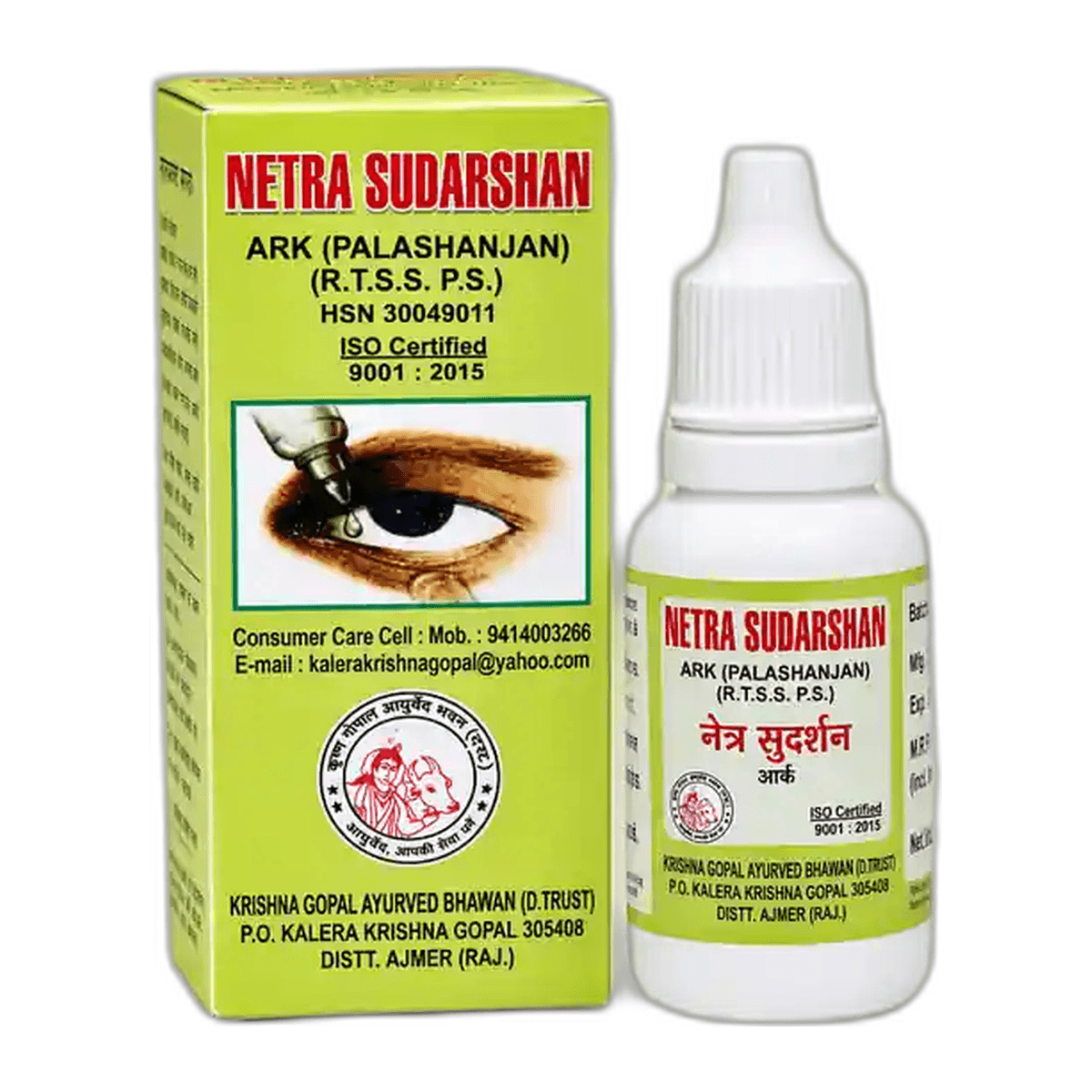
Netra-Sudarshan Ark (Kalera) Kalera
Anti-infective eye drops
Bottle of 15 ml
4.7
₹30Get ₹3 Cashback
₹3412% off
